Listeners:
Top listeners:
-
 play_arrow
The LBX Show #100 - Debating the Future of LBE, Intercard's OmniRay, & more!

Entertainment Social Arena #25 – Social Entertainment Shakeup!
AI Constructed Brief
The competitive socializing market is entering a shakeout, with weaker operators facing falling sales while established groups pursue acquisitions, restructuring and new formats. XP Factory sold its 29-site Boom Battle Bar chain for just over £11m, allowing it to focus on Escape Hunt; Ten Entertainment disclosed a £39.9m purchase of Fairgame. Moyagi acquired Lucky Voice’s brand and three London venues as other locations closed. In Australia, Signature Hospitality is investing in Varsity and Poolhouse, while Five Iron Golf is launching a smaller, franchise-friendly format. NQ64’s expanded Soho venue adds social games to its arcade-bar offer, reflecting operators’ efforts to broaden appeal and compete.
Full ESA Report
This latest ESA covers the changing landscape and fortunes for the leading chains and investments in the Competitive Socializing arena. Ranging from investment in redesigning of concept stores, as well as the acquiring and merger of key brands in the face of impacted revenue charted across the board. All while the market is evolving under difficult global conditions.
Social Entertainment Restructuring
Major shakeup in the competitive socializing scene was marked during September with the announcement that XP Factory PLC had divested their interests in the 29-facility ‘Boom Battle Bar’ social entertainment chain – selling the operation to F.o Twenty-Four for a suggested £11m. This marks a reversal on the plans to incorporate the multiple entertainment venue chain into their operation, including the addition of their ‘Escape Hunt’ chain into selected venues.
The ‘Boom Battle Bar’ operation first started in Norwich, UK in 2020 as an eclectic mix of garage mini golf and social gaming, the chain expanded, and in 2021 was acquired by then Escape Hunt PLC operation, who subsequently changed their name to XP Factory PLC. Several ‘Boom Battle Bar’s underwent the addition of an ‘Escape Hunt’ escape room installation, (such as the Oxford Street, London venue). But it was clear that this was a difficult acquisition and the chain has failed to live up to the promise.
It was revealed recently that ‘Boom Battle Bar’s then owners XP Factory had seen like-for-like sales fallen 8%, tracking a broader sector decline of 9% across the business. Reporting while revenue grew and also saw continued expansion to its ‘Escape Hunt’ estate during FY26 – a “significantly weaker competitive socialising market” that detracted on its ‘Boom Battle Bar’ business and profitability, with the corporation siting EBITDA falling to £5.5m, down from £6.6m. ‘Boom Battle Bar’ seeing EBITDA fall from 18% to 17%. News of this saw shares fall in the operation. And after reporting the decline XP Factory made it clear in a statement, they would be instigating head office cost reductions.
It would seem that the cost reduction move would prove more drastic than first thought, as only a matter of days after reporting these numbers it was revealed that XP Factory had sold the 29 ‘Boom Battle Bar’ venues for just over £11m to the new vehicle F.o Twenty-Four Ltd. This operation is backed by Frasers Group and comprises the original founder of the ‘Boom Battle Bar’ chain (Richard Beese). Later reporting would reveal that the F.o Twenty-Four operation would in fact be a vehicle for the transition to larger social entertainment chain We Do Play – adding the newly acquired mixed activity chain to their line up of representing ‘Flipout’, ‘Activate’, ‘PuttPutt Social’, ‘Rumble Rooms’, and ‘Laser Quest’.
Under the new We Do Play management it was reported that the brand is intended to undergo rapid expansion, with claims of plans for 50 new venues by 2030, along with applying new technology, games and experiences across the competitive socialising brands 29 sites. Five ‘Boom Battle Bar’ franchise sites will be retained under a new agreement. Sources revealed that 501 Fun would be supplying some of this new technology, including their new ‘Virtual Archery’ system. For XP Factory – this move allows them to focus wholly on their ‘Escape Hunt’ chain of some 40 escape room venues internationally. With plans to open another 50 venues before 2031.
This changing market and acquisition spree was reflected with the announcement from Ten Entertainment Group (TEG), who reported record turnover of £159.9 million. It was interesting that these reports it revealed the previously hidden figure the group paid to acquire ‘Fairgame’; being some £39.9m, bought in December 2025. The price had not been disclosed at the time, placing into perspective the value that TEG places in the opportunity to grow the competitive socializing brand – which operates currently two sites in the UK. While TEG operates over 58 sites of their bowling entertainment chain.
Founded in 2019, ‘Fairgame’ opened its first facility in Canary Wharf, London, and then after review opened a second flagship venue in City of London, next to the first ‘F1 Arcade’ site. We reviewed these sites extensively and were waiting of news of a roll out plan for the popular concept. The reporting of this record figures also reported the restructuring of the board of directors at TEG, and it is expected that there will be announcements of new plans surrounding their chain of operations in the coming months.
The changing landscape for the social entertainment and hospitality sector was reflected on in a statement made to Propel Info, from Professionals At Play’s Matthew Jones, the operations chief executive. He stated that the Competitive Socialising scene is going through a shakeout, which is creating opportunities for well-capitalised operators with strong brands. He went on to say he is expecting shakeouts, as groups explore acquisition and strengthen leadership. This statement seemed to underline the mood of many in the sector and was soon played out with following news.
Only a matter of hours after this statement and it was revealed again by Propel that Lucky Voice had announced it would be filing a notice of intention to appoint administrators and was considering undertaking major restructuring. This was caused by a downturn in their business revenue across their chain of six UK and one Dubai operations. No sooner had this announcement been circulated that a second announcement was made that Moyagi, the karaoke bar chain had acquired Lucky Voice.
Moyagi who operates venues in Stockholm and London, agreed to take on only three of the London sites (Soho, Liverpool Street, and Holborn), as well as acquiring the brand. While the Waterloo and Islington (currently under administration) London sites, as well as the Brighton and Dubai venues were close immediately. This move to acquire the chain by Moyagi primarily to establish and strengthen their market position in a changing market, (later information would suggest that the Dubai site had received a last-minute reprieve).
The “Private Karaoke Experience” brand had been defined by the launch of the Soho flagship Lucky Voice site in 2005. The operation had attempted to expand the brand, redefining the mix of social entertainment, karaoke and hospitality, looking at franchises. In 2007 the ‘Lucky Voice Tiger Tiger’ franchise was launched in Manchester. Eventually going on to open five venues across the Tiger Tiger chain – this would however end in 2021 with their closure. After testing the waters in Dubai, the remaining Lucky Voice operation was showing considerable stress, when it was revealed in 2024 of administrative moves across the operation, with the Islington site being temporarily shuttered. Now with this acquiring at least three sites and the brand will survive to dance another day.
These recent developments with Boom Battle Bar, and now Lucky Voice are seen as only the start of the “shakeup” indicated by leading industry executives. These mergers and acquisitions have also been accompanied by a hoard of C-Suite executive position changes. The fifth season of the ‘SoundOff’ Podcast having spun off its recuring series regarding hiring, departures and promotions in the entertainment executive corridors to report in depth the changing corporate landscape.
Restructuring for Success!
The investment in competitive socializing has seen a broadening of the coverage, along with movements into Europe and North America, we have seen the Asian and Oceanic sectors drive their own social entertainment venues. One such example is Signature Hospitality Group (SHG), the operation representing the TGI Friday’s brand in Australia, but also had its own social entertainment brands – this including ‘Varsity’. A mixture of live music, string bowling, beer and arcade over 9 facilities, mainly in the Perth region, have sprung into life.
The operation has expanded the ‘Varsity’ chain with a $9m investment into a breakout into the Melbourne region, planning to open in November their largest venue to date. Doubling down on the Competitive Socializing investment. SHG also has their popular ‘Sports Globe’ hospitality chain, but the group has also taken on a new property that they hope to roll out across the Australian market. It was revealed that along with the planned opening of a Los Angeles, USA facility, ‘Poolhouse’ – the projection mapped pool lounge concept was opening a new Australian venue in the coming months. SHG leading the charge in the first installation.
The redevelopment of concepts towards attracting franchisees has played on many chains minds as they look to increase their market penetration in a headlong rush with growing competition. This was illustrated by the announcement from Five Iron Golf that they would be unveiling a new version of their popular golf simulation lounges. The company revealed the new ‘Five Iron Social’ concept, offering a reduced 3,000-to-5,000-sq.,ft., coverage and a reduced three to five sim bay installation. This instead of the normal 10 to 15 sim bay installations seen at the original venues. With some 50 venues opened the company hopes this new format will offer an enticing smaller package for franchisees with a cost-effective licensing fee. But the big difference is not just in the size but in the business model, ‘Five Iron Social’ offering a 24-hour-7-days-a-week access model. Hoping that this “Planet Fitness-model” will appeal to the simulator golf audience.
This move is a departure from what we have been tracking with the development of the ‘Detroit Duckpin’ amusement and entertainment model added to the Five Iron Golf’ Detroit venue. A move for a more encompassing entertainment mix, with strong hospitality, following the Competitive Socializing drive seemed to be leading the chains thinking. But with the recent separation and reorganization of their greatest competitor Topgolf Swing Suites, it is obvious that Five Iron Golf has reverted to a “small-and-fast” rollout model going forwards. This also mirrors developments from their leading competitor Back Nine, who have championed their own 24/7 facility concept across some 260 venues. If this will still see a more entertainment hospitality focus from the company is difficult to say, now that they have pinned their “Social” brand on a smaller formfactor.
It is understandable what Five Iron Golf would look to emulate the Back Nine model, as that operation has seen an amazing explosion in new opening, rising from over 80 units in 2024 to some 260 venues today. At the same time Five Iron Golf has seen erosion of their business model from the likes of X-Golf and Swing Suite, and the need to keep viable in a changing market has led to as much diversification of concepts as possible, based on their core business model.
Only a matter of weeks after the announcement, and Five Iron Golf announced a second new concept. This time they revealed ‘Five Iron Lounge’, that represented a new licensing program that will allow hotels, bars, restaurants, and other businesses to add Five Iron golf sim bays to their properties. The concept includes Five Iron’s simulator technology, branding, artwork, furniture, and training. With this major pivot away from standalone venues, the company confirmed that the first licensing partner will be the beer brand BrewDog. With the operation planning the first installation of a ‘Five Iron Lounge’ will be at their Las Vegas brewery.
Retro Arcade London Audience – Part 7.
Taking place a few weeks before IAAPA Europe, and we attended another major VIP launch of a new entertainment venue. One which will have major ramifications for the perception of the competitive socializing arena, and also an impact on the already crowded London sector.
It was revealed earlier in the year that the retro arcade bar chain, NQ64 would be opening their third and most substantial move in the social entertainment market in the heart of the capital. The London Soho site would be NQ64’s largest venue to date, spanning two floors.
The facility previously was two closed nightclubs, ‘G-A-Y’ Late night club on the ground floor (closed 2023), and the ‘Borderline Club’ (closed 2019), comprising a single 42,000-sq.,ft., with the new NQ64 facility only employing 9,500-sq.,ft., of the available space, for now.
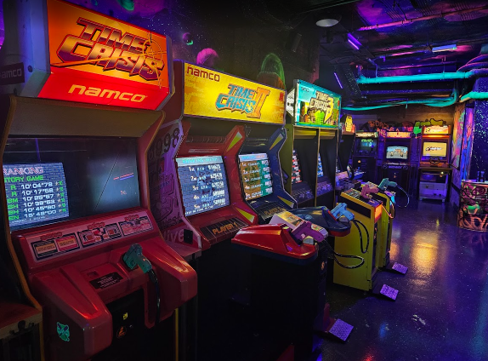
The ground floor comprises the more familiar NQ64 layout of bar and retro / classic amusement pieces (some 60 in number across the site). Along with their iconic bar layout and space for live DJ sets. While the new second floor offers a competitive socializing vibe to the space, with AR darts, UV pool table, along with its own bar and console gaming stations. This marked the biggest enhancement to the arcade bar offering, now fully embracing the competitive socializing business model, and offering a space that will offer a strong private hire component to their offering.
Regarding the amusement on offer, a mix of the classics were superseded by more modern classic video amusement, painting the trend towards more 1990 classics than the previous 1980 golden age retro. All of this powered using tokens, NQ64 leaning heavily into the nostalgia of coin-box action. The competitive socializing element of the venue is however powered by smart payment, a juxtaposition the operators will have to address at some point. Games range from retro to more recent classics and even a smattering of music game machines and pinball – and even two claw machines. Along with the console bays running popular videogame console hardware and classic titles. The crossover between arcade, console and social gaming an apt metaphor for the changing gaming landscape.
The private VIP launch was both a chance for influencers and local media to gain access to the new venue. But also, for many to come to terms with what this aspect of the social entertainment scene offers the London scene. Dispelling many myths that some had about what an “arcade bar” represents in the modern hospitality scene. The event was marked with special partnerships with Domino Pizza and Asahi beer for the VIP opening of the flagship. Asahi is already a partner with NQ64, the Japanese beer offered across the chain of venues.
This new Orange Yard, Soho location is only a stone’s throw from the original Berwick Street, Soho venue, first opened in 2022 with some 30 arcade machines, and established the blacklight basement arcade aesthetic, now a stone’s throw from the original Soho arcade scene of venues, such as ‘Las Vegas Arcade’, (one of London’s longest continually operational independent video arcades). With the opening of the new flagship Soho venue, questions were asked what the fate would be of the original NQ64 at Berwick Street. Started in Manchester back in 2019, NQ64 has grown to over ten locations across the UK.
Thematization / Design – 8/10
Entertainment / Socializing – 8/10
Quality of Hospitality – 8/10
Value for Money – 8/10
Overall Appeal – 8/10
It is interesting to chart the importance of the Soho region of London on the amusement scene. Ast stated, NQ64 opened just a stone’s throw also from the ‘Las Vegas Arcade’ Soho, an iconic venue that has charted the growth of the arcade scene back in the 1980’s when opened by then Family Leisure Group. Still open, the basement arcade is a vibrant snapshot of the modern amusement scene. Though there were several trends on display at the venue driven by player enthusiasm that are not on the order sheets of most distributors.
Just as we go to the wire, and we have been invited to the opening of the replacement to the original Berwick Street, Soho venue. It was revealed that this space would be launching as ‘NQJPN’ – this representing the first of a new late-night bar, club and Japanese arcade concept from the NQ64 team. We look forward to bringing you the lowdown from this opening, in the coming weeks.