Listeners:
Top listeners:
-
 play_arrow
The LBX Show #92 - Rerun: Annual Predictions Episode 2026!

#1277 – Amusement Theme Parks Return?
AI Constructed Brief
The evolving tech landscape reveals a shift from consumer VR to AI-powered smart glasses, with major players like Apple pivoting away from VR headsets due to pricing and market challenges, focusing instead on AI eyewear. Privacy concerns, exemplified by Meta’s aborted AI app ‘Muse,’ threaten to undermine smart glasses adoption, while Lenovo’s exit from XR enterprise signals industry contraction. Meanwhile, SEGA’s Joypolis celebrates its 30th anniversary, highlighting the enduring appeal of mixed-use leisure entertainment concepts. The amusement sector is witnessing increased facility investments, exemplified by SAI’s strategic push into venue development, signaling a broader move toward immersive, integrated leisure experiences for leading investors.
Full Stinger Report
Looking at the changing tech landscape, and the impacts across the amusement facility business of latest anniversaries and developments. We look at how privacy issues could seriously impact the roll out of smart glasses, major changes in tech investment into VR and the impact that SEGA chains have had on the changing mixed-use entertainment landscape.
Pivot To Glasses
The reality of the consumer VR scenes changing fortunes was further defined with news that one of the most anticipated developments in immersive technology was seeing further investment suspended. For many the media and electronics giant Apple’s entry into VR – or as they defined it “Spatial Computing” – was the definitive moment for the success of VR and would mark the move from niche to mainstream. Cementing the investment many had made into the hype-cycle that was virtual technology and by association the metaverse.
Following the 2023 launch of the Apple Vision Pro, with an eye-watering over $3,499 price tag, the wind has fallen out of the sails of the aspirations by some in the VR community. Hopes of renewed interest in the tech by a wider influencing fanbase, and the general “Apple effect” failing to materialize. Even rumors of a soon to be released low-cost version of the Apple spatial computer headset seemed to fall on deaf ears. And then the reality of the situation was broken. A situation not helped by the news during 2026 that Apple would be raising the price of the headset to $3,699 as their margins were impacted by market conditions.
It was revealed by a Korean news service that Apple had now decided to discontinue any development of a lower cost successor to their current Vision Pro platform. And that the company was fully pivoting towards their AI smart glasses development plans (with a system codenamed ‘N50’). The information confirmed from sources close to Samsung, the company developing the new display panels, for what had been rumored to be called the ‘Apple Vision Air’. This seems to be the final nail in the coffin of hopes for the VR entry by Apple, who had earlier in the year laid off or reallocated numerous staffers working on the Vision Pro strategy.
This marks the latest blow to the consumer VR community, after a string of VR game studio closures and layoffs, the ending of the “gravy train” from Meta in support of their VR platform, and the impact of the higher-than-expected pricing on the PC VR system from Valve. The hopes of survival of this aspect of the market seemed now to depend once again on that Meta would be able to ignite a ray of light for the sector. With Meta executives teasing plans to announce during September’s ‘Connect’ stage event, a new VR platform that could galvanise the market. What many see as a “make or break” move for the beleaguered corporation.
AI Privacy Invasion
Concerns for privacy invasion by new tech and apps enabled by AI have started to rise exponentially. This was best illustrated by the sudden launch and then closure and removal of the ‘Muse’ app by Meta. Working on the social media platform Instagram, ‘Muse’ allowed users to manipulate and create new images from photos captured off users’ accounts. The problem was that the users were not informed of the taking of their images and had no way to opt in or out of this feature. Meta would launch the app in July, only for four days later to hurriedly take down the service and then attempt to expunge all proof of its existence.
Meta’s amazing reversal was spurred by a massive user and public backlash against the AI manipulation app, and the obvious invasion of privacy that the image creation represented. The corporation would start an extensive damage limitation campaign to downplay the issue regarding the app, and then would finally completely remove, what was seen as a multi-million development and promotional campaign. The ramifications of concerns over privacy echoed those being raised about the other big AI project within the tech and social media giant.
Meta have been working hard to try and make their AI smart glasses aspirational purchases, linking them to celebrities, and fashionable luxury brands. Much of this attempt to make the smartware a fashion item has also seen the corporation attempting to downplay any concerns over privacy. The use of the AI smart glasses camera is linked to an indicator light – but a journalist found modders prepared to drill out the light so that clandestine video and picture capture was capable. Meta would rush a mandatory firmware update to block camera usage if the light had been tampered with, after the story broke in the international media.
The “Aspirational-Tech” against “Creepy-Tech” perception by the key customer base for the new AI smartware is a pivotal part of the strategy in developing these smart glasses. Making camera equipped smart glasses societally acceptable a key factor in this strategy. A strategy under attack as media reported that the AI smart glasses were starting to be referred in some quarters as “Pervert Glasses!”. As stated previously, all the major tech giants are looking at launching their own glasses. The tech seen as a safe business pivot from the wasted investment into the failed consumer VR headset business. Most tech giants now closing and laying off execs on their VR projects as the pivot to doubling down like Apple and Meta into smartware.
Lenovo Exits XR Enterprise
The latest of the major layoffs from the VR scene was revealed with the news that Lenovo would be making major job cuts across their enterprise XR operation in the US, that would see the end of the ThinkReality XR brand. The company would now be focusing on AI-native consumer wearable devices. The news of this move ending the investment into VR that the operation started in 2017, and over time has seen partnerships with first Microsoft, Meta, Pico and then Qualcomm.
The ThinkReality XR operation in the US seeing 11 of its departments closed and resulting redundancies, according to well-placed sources. The company having developed a range of VR and AR headsets under the brand. This move is seen as Lenovo abandoning its aspirations in the enterprise landscape to attempt to profit in the AI smart glasses market, joining the likes of Meta, HTC and other electronic manufactures to ride this wave towards establishing some semblance of market success in XR.
What impact this will have regarding the enterprise relationships established will be considerable. Not even to mention the investment that Lenovo has made into the educational market with their ThinkReality brand. Several schools and colleges depending on the brand to supply a VR educational framework. See Virtual Arena coverage from the UK educational sector for additional information. This moves away from enterprise seeming to reflect the same move made by Meta who abandoned their business-related investments.
Lenovo was one of the early supporters of a VR initiative, starting their ThinkReality XR division in 2018, following their partnership with Microsoft in support of their then Windows Mixed Reality project, (launching their ‘Lenovo Explore’ headset). With the implosion of the Windows MR initiative, Lenovo started its first partnership with Oculus/Meta, manufacturing the short-lived Rift S. The company would announce in 2024 another partnership with Meta to deploy their Horizon OS for use in Enterprise application. It is felt that with the shuttering of Meta’s commercial VR support (Quest for Business), and the changing fortunes of the VR scene in general they did not need their XR enterprise division.
This development will now cause concern for the remaining VR enterprise divisions. HP has been running their own commercial XR operation, selling their HP Reverb G2 headset. No word of any changes within the corporate strategy. Likewise, HTC has also had a successful enterprise operation based off their HTC VIVE division – the corporation recently announced in financial reporting the stabilisation of their revenues against previous significant losses. But like the rest HTC is also pinning future revenue on their AI smart glasses investment. As we stated previously, if the AI smart glasses boom is impacted by privacy issues could these pivots just lead to further abandonments.
Celebrating JOYPOLIS
Recognizing the anniversary of a momentous concept in the LBE sector seems fitting as this sector has once again moved into the ascendance. First launched in 1996, at the time part of the then SEGA amusement park division, the ‘Toyoko JOYPOLIS’ would be open. The concept was the culmination of the investment that the amusement giant at the time had placed into what they defined as large-scale high-entertainment “EN-JOINT SPACE”. A methodology that has seen the launch of the ‘R360’ deluxe rotational amusement platform, as well as concepts such as the ‘CyberDome’ and ‘AS-1’. Defined as medium-scale attractions.
These amusement attractions were envisaged as scaling up amusement interactivity into a theme park style attraction presentation. And that this new genre of amusement would need to be housed in their own indoor venues (Amusement Theme Parks – ATP). So was opened in Tokyo the first ‘JOYPOLIS’ venue, covering 103,000-sq.,ft., and multiple floors would encompass the strategy of a theme park in a box, with multiple specialist attractions and amusement housed in an entertainment hub. This would be in fact the second JOYPOLIS, 1994 having seen the opening of the much smaller concept store in Yokohama.
The name “JOYPOLIS” taking inspiration from the 1927 film ‘Metropolis’, inspired by the 1925 novel, and the creation of a futuristic urban city vision (“joy-city”). With much of the venues styling also inspired by the Art Deco themes. SEGA would go on to open another seven ‘JOYPOLIS’ venues in Japan and would look to export the concept under the ‘SEGAWorld’ brand internationally, seeing London and Australia getting their own sites. However, with the implosion of the SEGA amusement and entertainment operation, and their abandonment of venue operation the chain would see the ‘Tokyo JOYPOLIS’ the last survivor.
Then in 2016 the Chinese operation CA Cultural Technology Group would partner with SEGA to acquire control of the operation (SEGA Live Creation) and brand, forming the division CA SEGA Joypolis. This would see the first opening of a ‘JOYPOLIS’ entertainment venue in China. As part of CA SEGA Joypolis, the remaining venues in Japan and China celebrate the concepts 30th anniversary, and the corporation also promoted their continue innovation of the concept, launching their new ‘JOYPOLIS Sports X’ active entertainment concept.
What can we learn from the anniversary of the ‘JOYPOLIS’ operation. The first must be the application of the ATP concept to the market still seems of strong interest. As defined by our own definition as Mixed Use Leisure Entertainment (MULE), the idea of a space offering an indoor amusement park approach can be seen with chains like ‘Playdium’, ‘EVO’ and ‘Main Event’ in the States, and with the ‘Gravity MAX’, ‘Fun Station’ and ‘Babylon Park’ in Europe. The concept of ‘JOYPOLIS’ would inspire at the time the LBE sector, with ‘SEGA Gameworks’ and ‘DisneyQuest’ concepts borrowing heavily from the ATP approach.
Were SEGA foundered with their ATP aspirations was regarding the great expense of operation, and the constant need to feed the beast with new attractions. The SEGA AM R&D operation was hard pressed to be able to continue to support the ATP attraction needs as the expense of development spiralled, and the hope of splitting the expense with other venues failed to materialize. However, the concept of the ATP also ushered in the Transmedia craze, with the SEGA brand launched to ever high audience recognition through their unique venues. Current SEGA operation still licensing their brand to be part of the ‘JOYPOLIS’ operation.
That continued Transmedia promotion within the brand was seen with a new development. It was revealed that ‘JOYPOLIS’ was to get a brand new attraction. Called ‘NARUTO Music Dancer’, a multi-player computer vision experience places the gamers in the world of the anime character. Using Sony motion capture technology, the game represents up to ten players and their movements on screen in the game. The experience building on the popularity of the character IP. An installation very reminiscent of what we have seen achieved in the ‘ValoArena’ by ValoMotion.
Amusement Venue Investment
While SEGA Corporation (owned by SEGA Sammy) in Japan may have divested their interest in mixed-use facility operation, the UK company that licenses the SEGA name has increased their interests in facility business. SEGA Amusement International (SAI) was created out of the wreckage of the original SEGA AM Western operation through a management buyout in 2021. SAI acting as a distributor and developer of amusement products and service support. SAI run from the UK head offices, but with a satellite operation originating from the US Play It Amusement group handling sales and distribution in that territory. The whole operation controlled by Kaizen Entertainment as an umbrella holding company.
SAI has over the last few years started a serious investment in supporting facility operation, working with operators towards providing experience on machine selection, placement and support. As with many distributors, offering a wider support operation towards architectural and operational advice securing their business. This increased facility involvement saw SAI acquire the FunBox Entertainment operation in 2022. FunBox having installed and operated the amusement component for Gravity MAX, as well as opening several regional amusement venues. This would lead to SAI investing directly into the entertainment facility business.
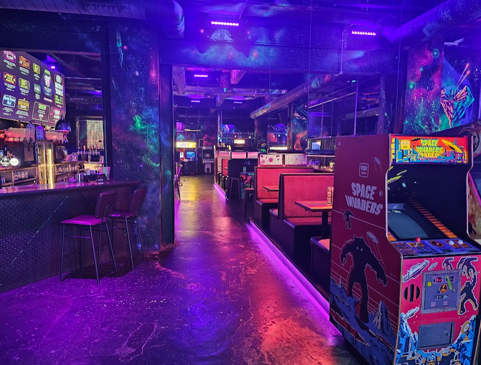
First with the opening of the ‘Urban Fun’ chain of two facilities and then looking towards a wider involvement with venue development. This has seen SAI partner with the flagship ‘Mega City’ facility project in Slough, UK. The 55,000-sq,ft,, site was developed from a £11m investment, and comprises a 10-lane bowling installation, and a 24-player laser tag space and VR attraction. SAI also worked with the operation in the design of their amusement space installing some 130 of the latest machines running off a SACOA cashless payment system. While also working on supporting a dedicated competitive socializing element to the venue with AR darts, projection mapped clay pigeon shooting, interactive football and pool tables all supported by F&B.
It is expected that this marks the beginning of a major push by SAI and other amusement distributors towards direct involvement in facility business. If this will mean a dedicated run of facilities of their own (away from the FunBox involvement) seems doubtful at this point. However, the amusement market is moving at such a pace that a need to move closer to the operations coalface is now driving the thinking of many previous manufacturers and distributors. Expect to see more venues that strike a closer partnership with SAI.