Listeners:
Top listeners:
-
 play_arrow
The LBX Show #92 - Rerun: Annual Predictions Episode 2026!

#1267 – Defining Immersive Punch!
AI Constructed Brief
The evolving XR landscape in Out-of-Home entertainment faces challenges amid industry churn, with notable closures like RED Tokyo Tower highlighting monetization hurdles. Strategic acquisitions, such as Vertigo Games’ closure and shifting support for VR headsets, reflect industry consolidation and operational difficulties. Meanwhile, the cinema sector is increasingly integrating amusement, gaming, and transmedia IP – exemplified by blockbuster-driven Cinetainment and immersive experiences – aiming to enhance audience engagement amid streaming competition. Major IP properties like Mario and John Wick underpin this trend, while new developments like Universal’s UK resort signal a shift toward comprehensive, IP-driven entertainment destinations, emphasizing resilience and innovation in a changing market landscape.
Full Stinger Report
Looking at the reshaping of the LBE XR landscape is focused on, along with the highs and lows impacting the operation of VR in the Out Of Home sector. While also looking at the latest investment in Cinetainment as the movie theater industry trade gathering reveals the interest in an entertainment mix.
Storm Clouds on the Horizon
There have been both ups and downs in the establishment of this latest phase of XR development. What the Stinger Report likes to perceive as the Forth Phase of this current generation of VR hardware in LBE, we have started to see a churn in developments, with both new investment as well as the whittling down of deadwood.
Claimed to have been Japan’s largest digital amusement park – RED Tokyo Tower, first opened in 2022 across four levels of the iconic landmark. The venue comprising several VR, XR, eSports and amusement attractions. In March it was announced that initially they would be temporarily closing for redevelopment – but inevitably confirmed that at the beginning of May 2026 they would be permanently closing. The operators claimed in social media statements that they would be redeveloping the concept, but well-placed sources confirmed this was a permanent closure and removal.
The Towers’ entertainment hub will now be broken up with several new independent XR venues opening in the vacated space. This will include the opening of ‘Boat Race VR Arena’ that was a previous attraction within RED Tokyo Tower and is now launched as an independent installation. The tower operation has had a tempestuous four years of operation seeing many short-lived attractions opened and then closed across the four levels. But claimed in reporting to have seen 130,000 visitors during this period. How many of them were ticket / attraction paying visitors was not made clear. It seeming to have been an ambitious project that found it difficult to monetize its entertainment offering. We hope the remaining XR installations learn from these lessons.
Returning to the VR scene, and a developer from the Third Phase of XR LBE – Vertigo Games had been purchased for $136m, by Kosh Media subsidiary Embracer Group in 2020. Following this the operation expanded its operation acquiring Force-Field Entertainment, later renamed to Vertigo Studio Amsterdam (2021). Vertigo Games best known for their successful ‘Arizona Sunshine’ VR zombie shooter series, that went on to the adapted for LBE VR application. Originally a version of the game (‘Arizona Sunshine Experience’) was created to be part of plans to roll our standalone VR venues from Nomadic VR in 2018 – while one venue on Orlando was opened, it soon shuttered and the plan was abandoned reverting to the game being distributed to all VR arcades.
Vertigo Games acquiring the VR arcade distribution platform SpringboardVR. In June it was revealed that Vertigo Games had taken the decision to close Vertigo Studio Amsterdam, which had become the VR and AR development operation of the group – stating the decision was made due to the challenges facing the VR industry. No word on the impact this situation will have on the SpringboardVR platform.
The impact of changing conditions for the XR landscape were compounded by economic conditions. Having only recently been reported in our AEI’26 show coverage, Verse Immersive was stricken with a terminal blow with the news at the beginning of June that their parent company Enklu (founded as in 2016 Emergent AR Platforms), had entered Chapter 7 and had started the process of liquidation. As reported Verse had been involved in a partnership to use the SNAP ‘Spectacles’ glasses as replacement to the Microsoft Hololens 2. Having started test installations at the cinema chain Micon Cinemas, as well as at 810 Entertainment, Main Event and Ripley Entertainment.
The company had struggled to find a strong business model, having developed both explorational and adventurous content as part of what they defined their platform as a “Holographic Theater”, (even releasing a “holographic haunted house” experience) for their AR platform using AR see-through technology and hand tracking. The reality was that the original hope of self-operating standalone venues had not succeeded, finding reverting to an AR entertainment space model a difficult fit. Compounded by the issues of having to pivot from numerous AR platforms, including the abandoned Microsoft Hololens2 architecture. Costly mistakes in backing the wrong AR headset to achieve their goals has been a recuring illustration of poor technological oversight.
The need to address the changing consumer VR landscape was made clear with clarification made by Hero Zone – the leading VR free-roam arena developer – that they are modifying technical support for operators of the Meta Oculus Quest headset on their platform. The company is addressing recent updates from Meta that cause issues with operation, customers needing to understand that it is a difficult task under the current conditions within Meta Reality Labs. Hero Zone will continue to offer technical support but cannot guarantee stability, along with that for all supported VR headset platforms from other manufacturers, though sources close to the operation noted that the company currently recommended the PICO 4UE headset because of its established enterprise credentials at this point. It is expected that other VR arcade distributors and VR arena developers will be issuing similar advisories to existing operators, the sudden abandonment of commercial / enterprise support by Meta Reality Labs a forewarning that cannot be ignored.
The drive now in VR free-roam arena business has not lessened – but has migrated into a more pragmatic position. While established operators still look on the interest from their audiences towards VR arena entertainment, they are looking for a much more professional installation and support approach. The hype promoting the technology from gurus, replaced by the need for solid operation to ensure ROI. Companies now being selected to provide platforms and turnkey support. This is illustrated in the news that The Rabbit Hole VR has been named the official VR partners for Urban Air Adventure Park – with the new standard VR attraction ‘Urban Air’s VR Zone’ powered by Spawnpoint, to be installed across entertainment center operation.
We expect to see other such official strategic partnerships in this sector, as operators look for dependable and reliable XR deployment, away from the hype of what the technology might be able to achieve.
Movie Properties Turn to Transmedia
One of the influential trade events leading up to the middle of the year was CinemaCon 2026. The theater operator and movie studio event was held at Caesar’s Palace in Las Vegas. An event that has become increasingly important not only for the new movie release roster that it promotes, but how much amusement and attractions, and possible cross over IP’s are shaping the entertainment landscape.
On one side the cinema sector seemed to be depending on some major tentpole releases towards guaranteeing their box office during difficult times, but among those releases, it seemed once again that amusement and videogame IP played a major role. ‘Street Fighter’ and ‘Mortal Combat II’ revealed their first trailer releases. Remakes of the previous movies based on the CAPCOM and Midway coin-op brawlers. As seen with the Mario, Sonic and Minecraft releases – videogaming IP is bankable in the troubled theater business. The bankability of the videogame property for movie releases best illustrated by the ‘Super Mario Galaxy Movie’ which has surpassed $755m globally, becoming highest-grossing film of 2026 by May. The Mario animated film franchise has surpassed $2bn at the global box office – and already the next instalment is in the works.
On the other side, the bankability now being pivoted into directly by the theater sector operating amusement and entertainment on site, as seen with the explosion in Cinetainment venues. The CinemaCon show represented the big studio presentations of their tentpole releases, hoping to wow the theater operators. But the show floor also represented the new technology of theatre operation, audience seating, and the growing amusement and prize machine deployment. Amusement presence at the show also depending on big IP from movies.
During CinemaCon26, Betson Enterprises took a familiar space at the cinema trade event, with examples of their latest amusement releases including film properties like Raw Thrills ‘Top Gun Maverick Arcade’, as well as prize and redemption releases from ICE Games and SEGA Amusement International. Sharing the Shaffer Distribution booth was Andamiro USA, presenting their Star Wars coin-pusher illustrating the movie IP links for amusement. While other well-known North American operations such as Bay Tek / Elaut had their presence at the event. Ensuring the correct operation and implementation of amusement in the cinema scene also saw Intercard come to the trade event and present their new hybrid ‘Impulse Plus’ reader.
The Cinetainment drive is not just about adding a selection of amusement pieces and merchandisers in a foyer, but a drive towards creating an entertainment destination within an enhanced movie venue – building on the need to achieve a greater experience for the customer. Venue chains such as B&B Theaters, EVO, Rec Room and The Light, along with many others, looking to offer a complete entertainment experience supported by hospitality amusement and top-level movie environments.
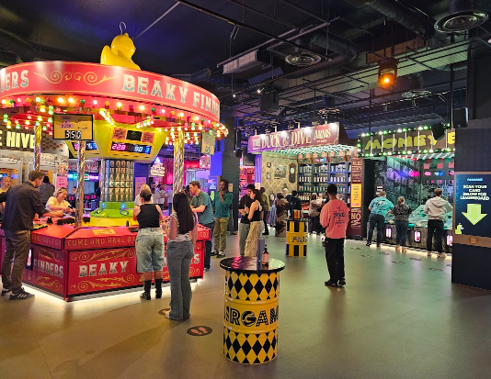
A Eatertainment operation that has depended heavily on movie related promotion releases was also defining its new direction. Away from the cinema event, Dave & Buster’s promoted a drive “Back to Basics” looking at IP game properties to give them the edge after disappointing same store sale declines by 5-percent. In investors call and recent media coverage D&B chief executive confirmed a returned to big game properties, looking at timed exclusive on IP branded content. It was confirmed in our AEI’26 coverage that the Lionsgate movie property ‘John Wick’ would be installed across some 180 stores. The title developed by Blue Motion Games. It was also revealed that a ‘Stranger Things’ amusement, based on the Netflix streaming series would also be placed across the venues, (sources revealing this to be a new Raw Thrills development). These unique amusement IP would also be supported by the ‘Human Crane’ machine attraction the company has deployed on property – in hopes of offering unique amusement to drive audience retention and boost sales. Sources spoke that D&B will be debuting 10 new amusement titles this year, trying to regain the high ground.
This would be followed by the announcement that Dave & Buster’s would launch for the first time in its history, its highly-ambitious new national brand platform, “What The Fun,” alongside a historic value offering 60-Day Unlimited Play Pass for just $1 a day – focusing on the corporates current ‘Back to Basics’ strategy, returning to game experiences. The issues impacting D&B are discussed in a recent Entertainment Social Arena (ESA) piece in our sister social entertainment service.
Returning to CinemaCom 2026, the event was filled with the latest updates in the projection sector, with exhibitors such as Christie presenting their new ‘Phazer’ range of laser projectors. The theatrical chain trade gathering reflected many trends impacting the sector along with the embracing of interactive entertainment. The theater business has seen a battle ground over immersive experience business personified by IMAX and the emerging Infinity Vision. During the trade event it was confirmed that there would be a certification for Premium Large Format (PLF) theaters, promoting this aspect of the trade.
The immersive experience approach to the next phase of cinema was also promoted from operations such as CJ 4DPLEX – that are looking at a greater penetration of their multi-projection cinema platform. With over 400 ‘ScreenX’ auditoriums globally, the operations are moving against the likes of IMAX towards offering a unique cinematic experience. IMAX having been a bellwether of the changing audience experience, reporting at the beginning of the year that 2025 had been their best year on record with global box-office revenue reaching a record $1.28b. Films such as ‘Avatar: Fire and Ash’ being top earning IMAX releases. The corporation looking at attempting to beat this record, looking to international expansion in territories such as India, as well as application of new venue technology.
It was a clear discussion point during CinemaCon26 that offering the audience a unique experience that competed with the impact of home streaming services was a factor in the survival of the sector. Large seats, 4DX, large format projection – along with Cinetainment, all playing into the thinking of the major corporations at the Las Vegas event. Development in the Cinetainment scene that emerged after CinemaCon included the signing of a partnership with C.H.E Group – the Australian operation representing several cinema and hospitality chains such as Intencity, EXCAPE Entertainment and MONOPLEX ENTERTAINMENT, and others for the region. It was revealed that the group was releasing a version of the ‘MirraArena’ concept as a standalone installation for cinema soundstages. Called the ‘Mirra Immersive’ the system comprises the VR party game stage and incorporates the cinema screen, along with the stadium seating to offer a new Cinetainment approach for the social entertainment concept. Along with this approach to cinema soundstage utilization, the explosion in large audience Virtual Adventure installations thrust VR once again into the theater arena.
One last major announcement made weeks after CinemaCon, that involved one of the largest movie IP holders was Universal – owned NBCUniversal, a division of Comcast Corporation – officially naming the UK themed attraction resort being developed in Bedfordshire, confirmed to be ‘Universal United Kingdom Resort’ – with a scheduled opening date of 2031. The venue will incorporate several popular movie brand IP into the attractions scheduled to be developed. This will be one of the largest Western resorts to encapsulate so many movie properties and will mark a new decade of transmedia integration for entertainment.