Listeners:
Top listeners:
-
 play_arrow
The LBX Show #92 - Rerun: Annual Predictions Episode 2026!

#1266 – XR Future Entertainment Frontier
AI Constructed Brief
Marking a significant shift in immersive entertainment, marked by a turbulent consumer VR market and evolving sector dynamics. Meta’s failed push into consumer VR, massive layoffs, and price hikes signal a retreat from mainstream consumer focus, while Valve’s Steam Frame and new hardware hint at a possible VR revival. Meanwhile, Apple’s Vision Pro struggles with sales and support, pivoting toward AI smartglasses. The sector is increasingly driven by commercial applications, transmedia IP crossover, and standalone XR ventures like Fever’s VR zones and VR arenas, supported by rising investments and strategic partnerships. These trends highlight a transition from hype to sustainable, IP-driven, location-based immersive experiences, reshaping growth trajectories.
Full Stinger Report
Starting this latest series of detailed coverage of the elements shaping the immersive entertainment landscape, and those sectors influencing the further growth of the scene. We commence with an overview of the turbulent consumer VR sector, and the obvious impact on the LBE XR landscape.
Consumer VR Set Free
While some blame the consumers for not embracing VR, we are faced with the reality that Meta failed to promote the platform and may have hyped reviews and positivity about its capabilities. We are confronted with a tale of two VR game releases, both expensive licensed IP – but one received massive attention – while the other seems to receive minimal promotion, just as the collapse of the Meta Ambassador program. A program created to promote a business plan, that would eventually fail and reveal the squandering of Billions of Dollars.
Rather than promote the opportunities of amazing VR immersion, Meta focused on a walled-garden approach employing mobile processor performance and attempted to establish their own dominance on a Metaverse in the shape of their Horizon World. After squandering over $80bn (from 2021 to 2026) on a failed marketing, promotion and development campaign; an orchestrated movement has attempted to claim that this was not a failure by Meta, but by the consumer. With the VR influencers’ loss of “support”, limited voices still praise the platform.
With the ramifications of the consumer VR shakeup, all eyes turn to Valve’s ‘Steam Frame’, PC VR, and if it can return consumer VR back to the expectation and wonder of the Kickstarter and CV1 aspirations over ten-years ago – could this be the restart of the VR revolution? Valve abandoned original schedule sale of the PC VR platform and their PC cube platform due to the RAM pricing and availability situation. This did not stop them from launching the new Steam Controller for the platform, seeing record sell out once launched – this suggested as indicating the response that can be expected for the Steam Frame.
News that Apple may be rolling back its investment into the Apple Vision Pro. The Spatial Computing platform saw an update to the processor last year, but no appearance of claimed smaller lower price version. News services have revealed sources stating that Apple has seen incredibly low sales in the region of 600,000-units for the $3,499 hardware, along with an unusually high rate of returns, compared to other Apple product releases.
With the changing of the top management of Apple, with a new CEO, it is being reported that the technology giant will be fully pivoting towards their AI smartglasses plans. This linked to rumors that Apple has started to roll back in-store demonstrations of the Apple Vision Pro and have wound down the support of any further Vision Pro development.
Into April 2026 and we learn the next level of layoffs across the operation. As the end of the “Gravy Train” implications are felt, Meta revealed plans to lay off approximately 8,000 employees, representing 10-percent of its global workforce, with the reductions effective May 20, 2026. This was the latest in a series of layoffs from the corporation, many of those finding out the termination of their position in a 4am email, (this would later be blamed on sacking a workforce split over numerous time zones). Active VR projects and business discussions cancelled immediately leaving suppliers high and dry. Further indication of the cutting their losses attitude within Meta.
The best indication of the turning off the spigot that fuelled Meta’s investment into their hopes to dominate their VR and Metaverse aspirations, was the drawing down of the subsidies they had made into the Meta Quest VR hardware. It was announced that between $50-to-$100 price increase on respective models of the Meta Quest 3 and Meta Quest 3S hardware. Sources suggested that Meta would be attempting to gradually increase the price of the VR hardware so it would be on a similar level as the expected Valve Steam Frame VR hardware. The “boiling frog” syndrome hitting the consumer VR community.
The continuing impacts of Meta turning off the spigot of funding has been the drawing of the curtains on consumer VR allowing sun light rather than hype and astroturfing of the actual situation. This has resulted in several VR game studios, having to face the reality of their situation and implement massive layoffs of VR staffers as they reposition, or shutter. One such studio that revealed massive layoffs was Survios. For long time readers of the Stinger Report, the name will be familiar as one of the first VR developers that looked at VR arcade development alongside their consumer game releases. Known for VR titles like ‘Raw Data’ and ‘Creed’ – the company had opened at least two VR arcades in 2017, which they intended to roll out as an empire. After less than positive reviews of their sites, and internal management difficulties the project was dropped, and the company reverted to making their titles available for other VR arcades to license. These layoffs were called considerable by some observers suggesting that the company has abandoned VR, after failing to meet sales expectations on their last major consumer VR title ‘Alien: Rouge Incursion’ in 2024.
One aspect of Meta Reality Labs business that receives very little reporting is that of the Meta operation in Japan. This distinctive side of the VR operation has found greater success in the region, not just because of the popularity of VR with the culture, but also their adoption of a serious commercial entertainment operation. This has seen the deployment of Meta Quest 3 headsets in officially supported commercial applications. One such example is the popularity of audience-based VR Concerts, held at cinema venues. One such deployment is ‘Le Sserafim VR Concert’. A VR experience developed on the headset based around a virtual performance from the five-girl band. The experience offered at 109 Cinemas Premium in Tokyo, accommodating over 100 patrons. Meta Japan supporting commercial application has still been hit by the decision of the American parent to end business support, and it is expected that further applications of “VR Concerts” will have to find alternative hardware.
These commercial applications of Meta VR hardware seem however to have hit a roadblock, with sources revealing that those Virtual Adventure and VR Concert operators that had initially employed Meta Quest hardware, have suddenly started an exodus to alternatives systems such as the PICO and HTC headsets. This in the face of the loss of all technical support and difficulty in operating the now suspended business opportunities. Recent layoff seeing a concerning spread of abandonment of previous VR investment and seen with the previously valued at $3.5 billion – RecRoom, a VR social gaming platform, shuttered its servers June 1st, despite reaching more than 150 million players and creators since launching in 2016!
Transmedia Crossover
The last few months have seen an increased gathering of trade events and expos that focus on the amusement and attraction mix but also reflect the growth of “Transmedia” thinking in the entertainment sector. What is meant by this is the crossover of both IP (Intellectual Properties) and branded elements, towards widespread application. From apparel, toys and now attraction deployment. Application of IP within bricks-n-mortar entertainment venues gathering speed.
Looking at the events that reflected these developments, and the TransWorld’s Interactive Entertainment Show 2026 (TWES’26), comprising the Halloween & Attraction Show, took place in St. Louis. Now some weeks from the gathering and the impact of the event can be seen. The show on the first day held their “Interactive Entertainment Mixer”, where it was seen that the live actor element of entertainment venue engagement stretches further than just the haunted realm. Many venues now included live costumed hosts interacting with experience guests. Also revealed during TWES25 was the increase of immersion.
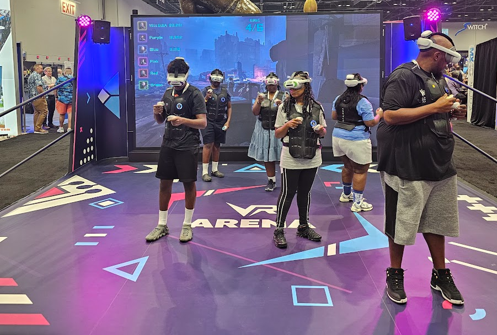
The show included an important VR aspect to its focus, with exhibitors such as vrCave and their extensive VR Escape Room catalogue. The company showing their multiplayer VR Arena experience using PICO headsets. The inclusion of a VR free-roam component to established Escape Rooms has grown in popularity. Turnkey solutions without the technical limitations of earlier platforms establishing this as a proven secondary revenue stream for operators. Moving more towards XR, exhibitor Arcade Arena, had a demonstration of their immersive game enclosure. Based on multiple projection enclosure with physical buttons and a serious of mini games. Immersive enclosures, an area of growing interest for the scare and escape room sector, representing active attraction business.
The TWES organizers confirmed their 2027 plans now taking the February 25-28 roaster in St. Louis. And are expecting to see a growing investment in interest in both the scare and haunted attraction sector, along with the escape room business. The proximity of this date to other amusement and attraction expos next year will be adding to a growing concern regarding marketing spend.
Regarding the turbulent situation of the live performance immersive entertainment scene was reflected in later announcements following the show. Reflecting immersive live performance element, and Layered Reality (previously known as dotdot), the company behind the immersive experiences such as ‘Gunpowder Plot’, ‘Elvis Evolution’ and the ‘Jeff Wayne’s the War of the Worlds: The Experience’ had reportedly fallen into administration and closed during May. Both Gunpowder Plot and War of the Worlds had depended heavily across their live actor and theatrical sets on VR experiences. Specially developed for the installations by Figment Productions, elements praised at the time for their innovation. More details on the ramifications of this development covered in our sister news service the Entertainment Social Arena (ESA).
An operation hoping to learn from its lessons, ‘Universal Horror Unleashed’, the permanent horror attraction, with four haunted houses and four themed bars and lounges at AREA15 in Las Vegas, revealed will open its first all-new haunted house and a new anime horror experience in 2027 with themed dining and new technical investment. The new developments aimed to turn Horror Unleashed into a year-round “horror lifestyle destination”. The reinvestment only 12-months on from opening showing the need to learn the lessons from audience feedback and to keep the venue relevant. This news equally important with the announcement of the second Universal Horror Unleashed venue in development for Chicago, slated to open in 2027. The need by Universal’s experience division to ensure that the second site (and existing flagship) benefits from an updated approach is essential to avoid stagnation.
XR Adventure in Standalone
Regarding the deployment of immersive experiences and it was announced that Sandbox VR would be pivoting from multi-player combative VR experiences, towards including the creation of VR adventures – launching ‘Age of Dinosaurs’. A much more Edutainment style of explorative / historical romp through a recreation of a prehistoric environment. The addition to the library of titles available to guests to the venue of an adventurous experience, harping back to 2018, and the launch of ‘Alien Zoo’ by the abandoned Dreamscape Immersive operation. While the Sandbox VR experience offers entertainment for up to six players, other large audience Virtual Adventure developments like Eclipso (Life Chronicles) and DIVR Labs (Meet the Dinosaurs) have also ventured down this path of experience.
As the corporation ushers to their 90th venue opening under their brand, Sandbox VR, announced that their LBE VR free-roaming arena experience ‘Stranger Things: Catalyst’ launched in 2025, based on the Netflix streaming series won The Webby Award, for “Best VR Headset Experience”. The application of IP based content driving the content narrative from the VR standalone venue operations. Leader Zero Latency announced the launch of ‘Jumanji’ VR arena based multiple player experience based on the Sony Pictures IP. As stated in previous coverage, this follows on from the recently closed The VOID LLC Jumanji experience that had been operated at the ill-advised Wonderverse venue operated by Sony Pictures.
Moving from the small scale free-roam experience to the large audience Virual Adventure platforms, and the big announcement the Netflix Black Mirror streaming series getting the VR arena treatment with the launch, initially in Montreal of ‘The Black Mirror Experience’. Developed on the Univrse large audience simultaneous VR free-roaming (XRoam) platform, with Banijam Studios working also on the immersive experience. By June the experience had been rolled out in New York and Madrid with additional international locations to be announced. From the deployment in New York at ‘The Shed’ venue – a flexible space normally used for art-based installations and performances. A similar layout as seen with the initially Montreal operation.
It was revealed that following this the Montreal location will be the launch pad for ‘Blade Runner: The Experience’. Developed by Behaviour Interactive, and co-produced with PHI Studio, in collaboration with Alcon Entertainment. This will be a VR adventure through the universe from the sci-fi movie blockbuster, with plans to be launched in 2027. The latest in streaming and movie properties developed into transmedial immersive experiences – this coming only a few weeks after the Licensing Expo event (reported later), which underlined how important LBE application of brands and IP are to owners.
The popularity of this medium in the Canadian region was seen with the announcement that OASIS Immersion, developers of a new permanent all-immersive 21,000-sq.,ft., facility also in Montreal – announcing their exclusive strategic partnership with Univrse / XRoam, towards developing a breakthrough projection-based immersion and free-roaming VR experiences – more details to follow.
An arms race in controlling the standalone facility operation business had gained momentum over the last few months. Fever announces the launch of their created and presented ‘Virtual Zone’ facility, at ‘Fever Hub Chicago’ – offering a VR free-roam gaming experience for up to 10-players – with a selection of four different VR adventures to experience. The latest development of this innovative immersive space. We have seen Fever Hub venues opening in North America and Europe, some including VR entertainment elements.
Fever also involved in representing many standalone venue operations as either a partner on “powering” the payment and booking component of the operation. This illustrated in the opening of the latest ‘Titanic: A Voyage Through Time’ experience, that has opened at The Galleries in Bristol, UK. The Virtual Adventure for audiences through a historic narrative of the fated ocean liner has been a popular pop-up exhibition at several international locations comprising a dedicated VR element, currently promoting the use of Meta Quest 3 headsets, but rumored to move to another platform. Fever empowering the operation. This can also be seen with the direct involvement by Fever with the Smithsonian Institution’s new ‘Starstruck’ experience. Bringing VR technology to the museum sector, with the launch of the new Immersive Experience groups can stroll through supernovas, float around exo-planets, in this free-roam virtual space exploration attraction. The Washington D.C. experience space employs HTC headsets – a one-hour experience developed by Virtual World.
While Fever is seen as a major player in the XR experience space both as an enabler and developer. Other operations are now pivoting to fight for a position in the new XR landscape. Greatly changed by the chaos in the consumer sector, operations are now doubling down on having a LBE XR presence. WeRiseUp announced a new Mixed Reality development studio, founded by Vekoma and PortAventura World – the new independent company focuses on theme parks and cultural heritage – the operation spun off from the PortAventura Adventure Lab operation. The involvement of Vekoma in this project points towards coaster-based MR attractions that have been developed such as the mixed reality roller coaster experience ‘El Diablo Neo’ launched at PortAventura World, the Spanish theme park in 2025. Or the previous first XR experience called ‘Hysteria in Boothill’. A free-roaming mixed reality attraction, launched at the park in 2024. It is these experimental attractions that have proven the worth of XR as a dedicated attraction pathway. WeRiseUp will be following in the footsteps of MACK One and VRCoaster operations investment in this field.
Looking at the greater investment into the XR free-roaming sector, and Esports Virtual Arenas (EVA) developer of VR free-roaming platform announced that they had closed a $35m round of financing with RAISE Invest – the company stating that they have 70 theaters opening worldwide over five years, with plans for 100 by the end of the year. Since their launch in 2016 they have entertained over 1 million players – with ‘EVA BATTLE ARENA’, a community of over 10,000 regular players has emerged in France. The investment will drive international expansion, especially in Spain, and other emerging markets. The company also looks towards launching their new ‘EVA Karting GP’. The move from the previous phase of VR adoption to that of room-scale and arenas has taken some operations by surprise. And we are seeing many redevelopments in business plans to make light of these opportunities.