Listeners:
Top listeners:
-
 play_arrow
The LBX Show #92 - Rerun: Annual Predictions Episode 2026!

Virtual Arena #23 – Train Hard, Fight Easy!
The consumer VR sector seems to be in freefall, but the reality of commercial application of the wider XR landscape is blooming. This however seems not to be receiving similar levels of publicity with the “gravy train” of Meta promotion of VR being derailed. The new vibe is to denigrate all aspects of VR, rather than shine light on the success stories.
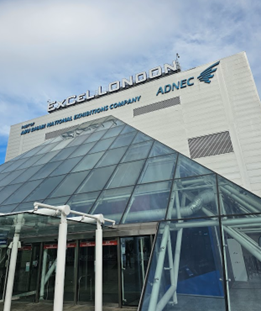
To redress the balance, we at the Virtual Arena continue to chart the investment and development of XR across the commercial space, without any ambassadorial commitments. And following on from our coverage of the XR Educational space – we now turn to the application in simulation during International Training Technology Exhibition & Conference (ITEC) 2026 – Europe’s largest dedicated event for defence training and simulation technology. Taking place at London’s ExCel conference venue.
London Calling
We have been a regular attendee to the defence and commercial simulation conferences over the years. The cross over between technology applied in representing virtual environments, and synthetic representations finding an eventual home in the Out-of-Home entertainment landscape, (our natural home). This year’s ITEC was an important landmark gathering as the international defence and training sector increased funding, and where XR moved from the latest “shinny” to proving its worth.
ITEC attracted some 70 international training technology experts across the sector, and along with the proven screen and display based media, the inroads of XR technology were very visible. The applications of this technology seemed to fall clearly between the demarcation lines of VR, AR and MR applications – though the military and training industry have a more nuanced view on the definitions of this technology.
Virtual Engagement
The biggest development in the VR training and simulation scene on display, was the perfusion of three key headset providers. While a smattering of Meta Quest 3 units was on display, those were fundamentally being employed as expo demo units, cost-effective enough to use as casual demonstrators, but unable to offer the needed fidelity of PC VR need for actual fieldable hardware in real simulation training.
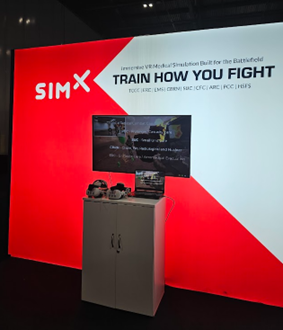
Those that have been following the commercial VR scene will be familiar with Varjo Technologies, and their successful deployment of headsets into the automotive, architectural and aerospace sector. These “military-grade” headsets were one of the ubiquitous platforms seen at this year’s ITEC. With several booths running demonstrations of real-world training systems on their hardware. The company had their own booth at this year’s show revealing some of the applications they see their new range of XR-4 series VR and MR headsets employed within.
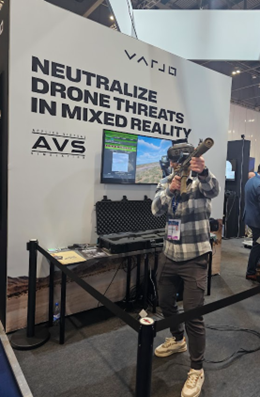
Regarding pure VR application in training, and a weapons demonstrator was seen offering training in the neutralizing of UAV (Unmanned Areial Vehicles) targets. A practical demonstration of a training system, that has the instructor controlling virtual drones that the user needs to shoot down.
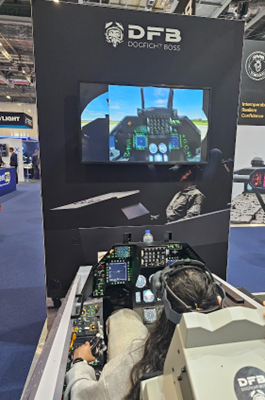
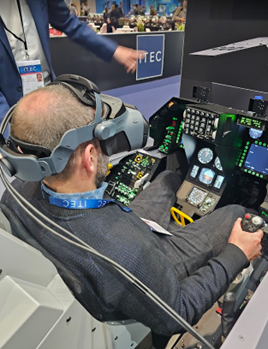
Varjo also partnered with flight cockpit developer Dogfighter Boss (DFB), with one of their F16 flight cockpits. Users were able to take control of the fighter jet, with the real internal cockpit controls visible through the Varjo MR capability, while seeing the virtual fuselage and environment, as if flying the real aircraft. One of several MR headset cockpit demonstrators seen at this year’s event.
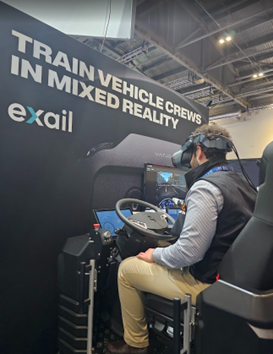
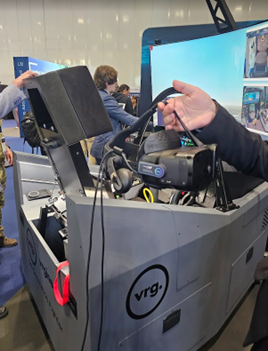
This MR approach was also applied to vehicle simulation with an example of a motion drivers rig from exail on the Varjo booth. With full controls able to offer the actual instrumentation from the vehicles cab incorporated into the virtual environment, that the user is driving within. This high fidelity of PC VR simulation needed for effective training. A level of motion, simulated instrumentation, and virtual environment visuals that are defining the sector.
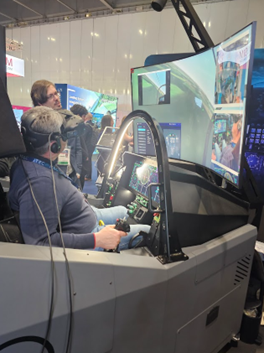
The full task simulation training headset was also seen from VRgineers another stalwart developer in the commercial sector, the company had their new Somnium VR1 MR headset, supporting both VR and MR application. Demonstrating the system with a full flight cockpit system, allowing the cockpit, instrument panel and pilots hands incorporated into the flight simulation environment. These high-end systems include eye-tracking and large FOV along with PC VR performance.
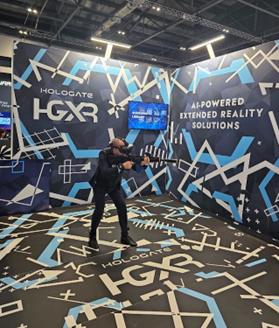
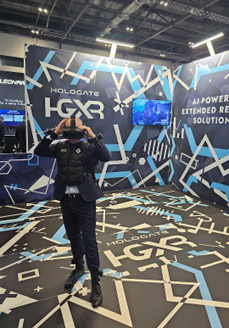
The other big name in the commercial VR headset application was HTC, represented on several booths. On the HGXR booth, the operation had a full demonstrator of their Arena based VR training environment. Currently employed by the German army and other training operations. The system deploying HTC VIVE Focus headsets, offers a full selection of AI-powered extended reality environments for infantry and law enforcement training with realistic weapon recoil weapon system developed by the company, and even the use of the bHaptics vest for haptic feedback, with this full body tracked platform. HGXR is the enterprise division of HOLOGATE, a company some of our readers will be familiar with regarding the entertainment VR arena business. An example of the cross-over of this technology from high-quality PC VR simulation to immersive entertainment.
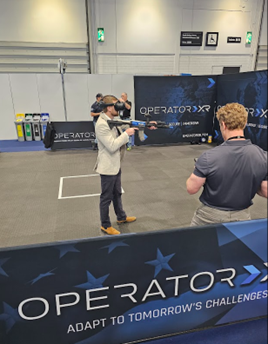
On the OperatorXR booth, demonstrations of their portable VR training platform for military and police, was shown that can be easily deployed as a training and rehearsal system. Based on HTC VIVE Focus headsets with several multiple user training scenarios, controlled by the instructor.
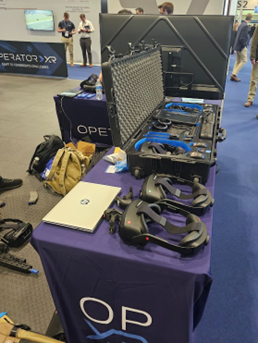
The status of HTC headsets in the commercial sector has cemented their position as a provider for free-roaming PC VR applications, able to support wireless VR streaming from a base PC platform. We are expecting additional announcements from the hardware provider on their next phase of PC VR headset support which will have implications for both commercial training and entertainment.
Mixed Entanglement
The training and simulation sector has come to underpin the definition of technology, more from actual application than the more theoretical attempts by the consumer XR sector. For example, true deployment of Mixed Reality was in evidence at ITEC.
Exhibitor multiSIM offered several cockpit simulator training systems they integrate for fixed-wing and rotary simulation applications. They had a demonstration of their MR (Varjo) helicopter trainer, employing the mixing of real-world cockpit and operator hands into the virtual environment created from the simulator. Real operation mixed with the simulated environment achieving a higher fidelity of immersion. The marriage of Chromakey compositing and MR headset performance creating one of the most compelling demonstrations.
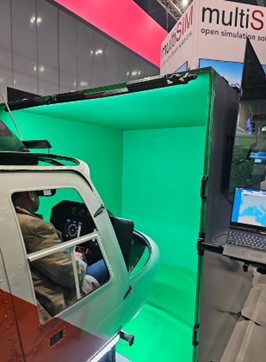
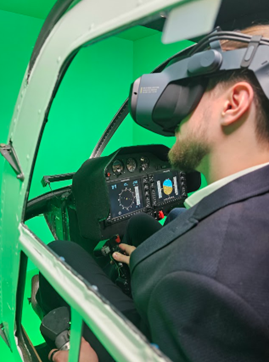
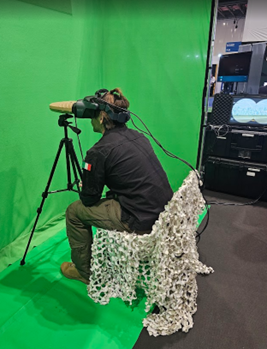
The use of MR technology employing the Chromakey application was also seen from companies such as Mission Systems SA, who used this approach to place the user directly in the virtual battlespace, simulating the use of artillery spotter glasses within the mixing of virtual and physical elements, in a multiple user environment.
Augmented Visualization
One of the hardest aspects of commercial XR technology innovation is securing reliable hardware and firmware providers, for solution developers. As recently seen, commercial developers that had hoped to depend on Meta Reality Labs support of their projects were cast adrift by Meta management repositioning their support of further enterprise projects.
The same is true in AR development – many commercial developers had been dependant on Microsoft, and their Hololens AR business initiative. With its abandonment the worst had been feared – but luckily several developers have filled the void. Exhibitor QuaternAR was demonstrating a perfect example of the move to replacement hardware. Showing Korean developer P&C Solutions METALENSE platform, offering the same form factor as the previous Microsoft system, but now with a more powerful lens display and Qualcomm processor. Another fundamental improvement is the employing of an object positioning infrastructure that improves the solid placement of virtual within the real world. QuaternAR was able to demonstrate on both their older, and now new headsets the use of this valuable visualisation tool for information assessments such as maps and collected environmental data like a real reconnaissance and UAV / satellite imagery.
With the genie out of the bottle, it is impossible for manufacturers to dictate the structure of the business, with the threat of “taking their ball” away from developers. Those very fabrication operations that manufacture the hardware in the first place now able to fill the void with comparable – if not better – solutions. The higher margins of a commercial focus rather than cost-cutting consumer aspirations sealing the deal.
Exhibitor InVeris presented their latest world-class force-feedback and haptics weapons simulation systems and showed the employment of state-of-the-art AR glasses for application in weapons scenario training. This latest fats AR system offers realism for the best possible training and muscle memory for performance enhancement.
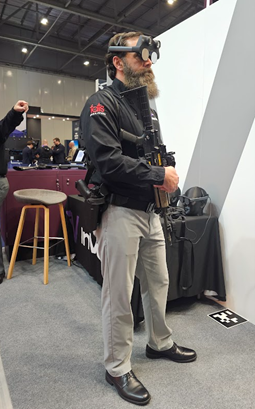
Actual practical example of AR headsets being employed in real world conditions were evident during the defence and training event, with the use of diving headsets augmented with display information. Real applications of this tech’s utilization.
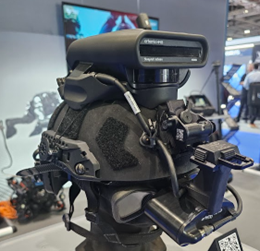
One observation from ITEC 2026 was, with such a perfusion of headset demonstrations, the one aspect that seemed missing was a more effective hygiene policy across exhibitors. At no time did we see any employment during the show floor of wipe down or sterilization. We feel the show organizers and exhibitors will need to consider a more robust hygiene procedure in the future. We would point to that already being implemented in the commercial entertainment landscape from our friends at Cleanbox – who have published a multi-organization collaborative effort towards creating an effective approach for managing hardware. The Comprehensive XR Hardware Management Guide can be obtained for free here: https://cleanboxtech.com/wp-content/uploads/2025/10/Comprehensive-XR-Hardware-Management-Guidebook.pdf
It was amazing that the access VR media were absent at this vast array of VR, AR and MR technology. While accreditation to a defence event may be one barrier, the lack of incentive to report on commercial developments seems inbred into their DNA. An attitude that will have to change if the VR media sector will hope to survive now that their additional “benefactors” have turned off the taps to promote the “consumer” side of the medium.
Display Technology
The more conventional application of display technology via projection, also saw innovation and application on the expo floor. Large display technology is being used more in command data headquarters offering detailed data accumulation of the changing battlespace from air and space-based assets, along with data collected from forces on the ground. Along with display environments, ITEC’26 promoted the latest conventional simulation displays used in air, sea and ground vehicle training – much of which still depends on projection-based displays.
A joint booth presentation from Norxe, Scalable Display Technologies, GBvi, and AMST Systemtechnik showcased a fully integrated immersive solution. Alongside the screen, Norxe’s LED/NXL projectors, AMST’s CGI engine, and Scalable’s automatic warping and blending, GBvi introduced its interesting Chronos technology. Rather than relying solely on processor‑based blending across multiple channels, Chronos uses physical optical filters precisely calibrated to the dome geometry and the projector and lens characteristics. This approach delivers seamless edge blending and a single, expansive image across all time‑of‑day scenarios. Originating in simulation, the technology is now being adopted by planetariums and large‑format dome attractions, enabling deeper blacks and greater immersion, and demonstrating the continued relevance of optical solutions within modern immersive display systems.
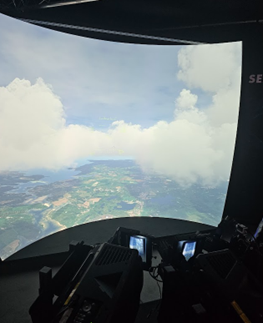
Overall, ITEC 2026 offered a valuable snapshot of the application of XR, both from the more conventional advancements in projection tech, but also the establishment beyond the hype and speculation, real-world innovative application of immersion across all aspects of AR, MR and VR. Several of the publicly presented applications demonstrated, clearly offered cross-over applications into the entertainment sector. While several embargoed demonstrations presented tantalizing glimpses of next-generation applications that will drive the revolution of XR immersion far beyond VR headsets.
This concludes our latest overview of the technology shaping the commercial simulation and entertainment arena. The impact on Digital Out-of-Home entertainment continues to grow, and we will continue to chart these changes. Watch this space for our next extensive feature.