Listeners:
Top listeners:
-
 play_arrow
The LBX Show #98 - Guest Gab w/RSA, IAAPA Insurance, Arcade mix & more!

#1275 – Riding the XR Wave – Part 2
AI Constructed Brief
At AWE 2026, leading investors observed a strategic pivot in XR, with a renewed focus on Location-Based Entertainment (LBE) and enterprise applications amid sector volatility. Qualcomm’s dominance with XR2 Gen2 processors, alongside new headsets from Lynx, Samsung, and Canon, signals a shift toward more affordable, powerful XR systems. The event highlighted significant advancements in LBE content, including collaborations with Universal Studios and the recognition of LBE in Auggie Awards. The decline of consumer VR investment, notably Meta’s retreat, has accelerated industry interest in out-of-home XR experiences, positioning LBE as a promising growth frontier.
Full Stinger Report
In the second part of our coverage from Augmented World Expo (AWE) 2026, and we continue with the investment into the MR and AR aspects of the new XR tech race. And look at the other aspects of the expo, conference and awards that drove market interest.
Doubling Down on XR
The Californian AWE 2026 expo revealed the need for the best XR systems, at the right price, was born out across the event; with many of the new systems being applied to LBE XR. Exhibitor and sponsor Qualcomm took a prominent placement, the company’s processors empowering the majority of XR wearables at the event, and in the industry in general. On their booth they demonstrated the slew of applications empowered by the chipsets. The company also teased their new XR2 Gen2 chipset for immersive platforms including the new range of MR headsets. Already PICO, HTC, Samsung and Meta depend on processing power from the corporation.
News away from the Long Beach show, and the French developer Lynx. The company had presented their ‘Lynx R2’ headset, hoping to offer a unique MR platform, and empowered by Qualcomm XR2 Snapdragon XR2 Gen 2 processing. The system would be sitting alongside the Samsung Galaxy XR, the new PICO Swan, and a possible new entrant from Meta. But it was confirmed in April that Lynx had entered liquidation. Sources would later reveal that EssilorLuxottica was acquiring Lynx assets, and this would drive hopes that the hardware would be seen again.
This and other news an indication of the volatility of the changed XR landscape. Prior to AWE the news of VR studio closures and layoffs filled the media sites. The removal of much of Meta’s investment into the VR space sending shockwaves throughout the sector. Meta was present at AWE’26 with both on show closed booths and private meeting rooms – but it was clear the operation was focused on an AI / AR trajectory. Many that had banked on Meta Quest headsets for LBE application seeing the writing on the wall.
Another prominent exhibitor and sponsor at AWE’26 was Samsung – one of the dominant forces in the MR and VR sector, their display technology employed in the majority of headsets built over the last ten-years. The corporation had on booth examples of their display and computing advancements – as well as their own entry into the MR headset scene with their Galaxy XR platform, developed in partnership with Google towards creating a unit to support both consumer and enterprises needs in the changed space. Another powerhouse in the sector, Canon presented at the Californian expo, with examples of their XR MREAL platform, and their collaborations with AR smart glasses applications.
Conference Time & Awards
Along with the 400 speakers across the conference, a dedicated expert talk and panel session was assembled at the Gaming and LBE Hub at the expo. Regarding the LBE portion of the seminar program, KWP had been retained to help lead the presentations and moderate the sessions. Following a keynote that outlined the scope and opportunity of the LBE XR market for the assembled audience, sessions included Itseez3D and HTC VIVERSE operation outlining the creation of Avatar and digital humans employed in LBE content.
Other sessions included scaling LBE for Japanese deployment, presented by STYLY alongside KDDI with their attractions work such as the ‘Ghost in the Shell Exhibition: DEN-NOH VISION’ XREAL experience and the ‘AnimaLOOK’ experience at the Tokyo resort. The developer announced they would be making their development foundation for LBE content creation open-source, while also strengthening partnerships with device manufacturers including PICO.
LBE XR Zone exhibitors Hololabs Studio gave a session recounting their work with Universal Studios on the ‘Mario Kart’ AR attraction, and how they applied these experiences to the work on their new VR free-roaming games as well as other projects. A fireside chat session saw DreamPark, along with Dave & Buster’s discuss the deployment of the new ‘DreamBox’ MR kiosk system within the Eatertainment chain, and the issues in creating strong MR content for LBE.
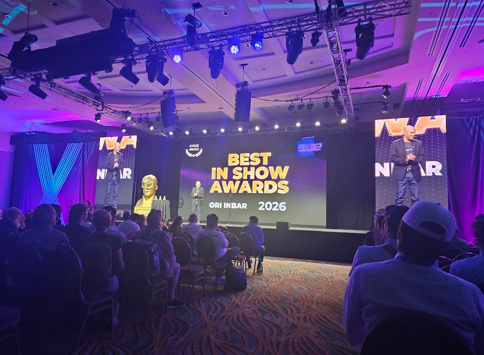
Another aspect of AWE that has come to define the event over the last 17-years is the holding of the “Auggie Awards”, recognizing excellence and achievement in the VR, and AR industry. This year the awards included new categories, with LBE XR being recognized. KWP’s founder was invited to be one of the judges voting on the finalist selected. The award for “Best Location-Based Entertainment” was given to ‘Interstellar ARC’ by Felix & Paul, currently installed at AREA15 in Las Vegas. While vrCAVE won the “Best In Show – LBE Zone” Award. Congratulations to all the other recipients of Auggie Awards – well earned, and great to see the continued investment in the sector.
New Interest in LBE XR
Away from the LBE XR component, but still a major part in supporting the enterprise aspects of the business was VR-Expert. The company exhibiting their support of VR and AR hardware and software support for the enterprise scene. Another major supporter of the LBE XR scene exhibiting was bHaptics, showing their latest haptic vest and gloves applications – many of which will be finding their way into LBE facility utilisation.
Another exhibitor outside the LBE XR Zone turning attention to location-based opportunities was RP1. Through their ‘Open Metaverse Browser Initiative’, an open-source project under the Metaverse Standards Forum. RP1 attempting to build new standards for the open metaverse. The evolution of the website into spatial experiences that will power the future of AR glasses, virtual spaces, physical AI, and robotics. Its open source ‘Sneeze’ engine can be embedded into existing web browsers, built directly into devices, or used to power standalone metaverse browsers. The hope in giving the whole industry one open foundation to build on. Seeing clear potential in digital twins for facilities and events, alongside the obvious LBE games and activities.
While LBE may not have been the key focus a year ago, many exhibitors across the rest of the AWE’26 show floor were now heavily leaning towards an out-of-home entertainment application. One such was new startup Monsarrat – demonstrating their new title ‘Landing Party’. An experience that mixes virtual elements into the real world, offering a compelling game for both smartphone and MR headsets. Building on the proven drawing power of Pokemon Go!, but with a configurable large environment model. Offering an outdoor RPG, in what the founder of the company has defined as being “Landscape Reality”.
Expo exhibitor Reality Check represented an immersive entertainment discovery platform, allowing audiences to find VR, AR, 360’ and now location-based entertainment experiences. A database of content accessible to all, including the purchasing of tickets, and nearest venue details. The platform aims to help struggling content creator’s gain visibility, expanding to embrace LBE XR content. One of those content creators was fellow exhibitor VirtualGo. Known for consumer mixed reality experiences, the company has expanded into location-based entertainment, offering commercial licenses that turn any size or shaped environment into a playable MR game for LBE facilities.
While not using VR or MR headsets, the University of Central Florida (UCF) showcased a telepresence system that combined an immersive 3D projection environment with a Virtuix Omni One omnidirectional treadmill. The operator views via the immersive 3D projection enclosure the world seen by a robot that they control. A fascinating example of telepresence, as the robot navigated the show floor.
Speaking of Virtuix, we were able to catch up with the VR developer of the popular omni-directional system. As we have reported the operation is now a public company – focusing their market effort on their new ‘Omni One’ platform, for consumer and some enterprise applications. Regarding the LBE sector, the company has been incredibly quiet concerning their support of this entertainment market. In exclusively speaking with us, Virtuix clarified that they had installed over its history some 80 ‘Omni Arena’ systems. But obviously, the turnkey multi-player eSport VR attraction, using HTC VIVE headsets, was launched in 2018 and much has happened since in the sector.
Virtuix confirmed they stopped producing the arena in 2025, but actively facilitates secondary sales, and support remaining operators through the Omni Care maintenance service. There are currently no plans to return to the LBE XR scene with their new omni-directional platform. That said, from a review of the over-40 still operational ‘Omni Arena’ platforms across the sector, they are still generating valuable revenue for their venues, along with tournament business. An impressive testament to the Virtuix platform. And an under promoted indicator, no matter the hype, of how VR has generated serious returns for those facilities that have continued to operate the tech professionally.
Away from the VR and AR, AWE exhibitor BLAMO! reflected the coding and modding that also is encapsulated by the XR expo. The company demonstrated their ‘Spacebar Arcade’ – a Vibe-coding platform allowing users to create AI game content played on a mini arcade game cube, as well as played on VR headsets. The growth in vibe-coding (using simple natural language prompting am AI to create content), expected to be seen appearing in mainstream game development. AWE 2026 included several exhibitors, roundtable sessions and mixers expanding the impact of AI development in the XR sector.
In Conclusion – This first AWE comprising a dedicated LBE XR Zone proved a compelling and overall successful gathering. Still impacted by “first show” growing pains – as some companies attended to see what was happening rather than exhibit, this was still a strong draw, and a foundation the organizers are preparing to build upon for the 2027 expo. The organizers are also looking across their other European and Asian expos to incorporate a LBE element.
The watch word for the show was “serendipity” as presented at the welcoming keynote presentation that commenced the expo. Defining the way that tech was applied to applications that were accidently discovered as being the “killer app” that defines the platforms use. For the consumer tech, that moment where the customer base says, “I need that”! While consumer VR may have fallen on hard times as it looks to find a new champion and reinvigorate investment. AWE proved commercial applications of XR have reached that “I-need-that” moment.
The XR sector will see the next big gathering with the cojoined AWE event United XR Europe, in December, in Belgium. While next year there will again be AWE USA 2027, in June returning to Long Beach. This will be followed by AWE Asia 2027, in July in Shanghai. We hope to report on an expanding LBE XR Zone offering for these events, along with news on how the LBE sector can play their part to define, grow and evolve in this compelling market.
The Pivot to LBE XR
It would be difficult for even the most jaded of observers to ignore the sudden interest in LBE at the AWE Expo. The implosion of the consumer VR scene aside, enterprise and along with that commercial entertainment applications were seeing newfound interest. Interest from content and application developers, as a more secure route to market, and offering a more defined business opportunity.
For many VR developers, the derailing of the consumer VR gravy train has revealed a truth that hype alone can not pay the bills. Also, for many the realisation that the consumer VR sector had been artificially propped up by the considerable investment by Meta towards controlling the sector has hit hard. With the withdrawal of that said investment (estimated as being some $80b over the last five years), AAA game studios developing VR content have shuttered or instigated massive layoffs as they reallocate resources to survive.
That “investment” that Meta had injected into attempting to control the consumer VR sector took on the face of three key areas. The subsidising of VR headset hardware. The creation of a centralized content delivery platform (defined as the Metaverse threw the ‘Horizon World’ portal), and the control of the message to the sector. This last area saw media and influencers encouraged to only focus on one aspect of VR delivery, and to only praise a standalone mobile VR approach to adoption. Any discussion of other approaches or markets was discouraged by the removal of access to information or funds.
Now with the removing of the veil from their eyes, many VR industry observers have been surprised to see there is an industry outside of consumer. With out the censorship, surprised coverage of LBE applications ranging from the new large audience free roam adventure systems to the continued growth of VR entertainment centers can now be reported without fear of being pressured by those controlling the taps. What this will mean for the future of the VR scene going forwards is difficult to say.
The continuance of consumer VR is now dependant on a reboot towards a PC VR future, dependent on the success of the new Valve Frame VR headset hardware. If this is impeded by a higher-than-expected release price then it is expected that VR will continue to be a niche technology, and as with the tech sector, it will move on to other interests. Whatever the case the LBE application seems to be gathering greater momentum, and with that a great understanding of the opportunity it offers to developers.